

You’re staring at a vendor quote for an upcoming birthday party and suddenly you’re reading words like “turns,” “flatware,” “linens,” and “lead times” like you stumbled into a professional catering manual. This confusion is more common than you’d think, and it can quietly cost you money, time, and peace of mind when planning any celebration. Understanding the language that party supply professionals use every day puts you in the driver’s seat. You’ll avoid costly mistakes, communicate clearly with vendors, and actually enjoy the planning process instead of feeling like an outsider.
Table of Contents
- Why industry terms matter in party supply
- Common party supply terms: What you’ll actually hear
- Planning parameters: How industry lingo drives the process
- Translating terms to action: Consumer scenarios
- Perspective: What most party guides don’t tell you about industry lingo
- Get party-ready: Shop supplies and put these terms to use
- Frequently asked questions
Key Takeaways
| Point | Details |
|---|---|
| Decode industry terms | Learning key party supply terms makes working with vendors smoother and less stressful. |
| Focus on planning benchmarks | Start party planning by determining guest count, duration, and deadlines for smarter supply decisions. |
| Map jargon to real needs | Industry categories like ‘tables’, ‘turns’, and ‘centerpieces’ directly impact your shopping list and event setup. |
| Apply terms for better deals | Using professional language can help you negotiate prices and avoid unnecessary extras. |
Why industry terms matter in party supply
With expectations set, let’s dive into why the language of party supply professionals is different from what you might expect.
Most consumers think about parties by theme first: rainbows, dinosaurs, superheroes. Industry professionals think about events by function and logistics first. A vendor doesn’t start by asking what your favorite color scheme is. They ask about guest count, event duration, and supply categories. That difference in approach is exactly why their vocabulary feels foreign at first.
“The gap between how consumers talk about parties and how vendors quote them is mostly a language problem — not a planning problem. Once you learn the vocabulary, the process clicks into place.”
The practical value here is real. When you know what a vendor means by “linens,” you don’t accidentally assume they’re talking about tablecloths for the dining table at home. In industry terms, linens covers a full category of fabric items including table covers, napkins, and skirting. Misunderstanding that one word could mean you show up on event day with uncovered tables.
Organizing party supplies becomes dramatically easier when you group items the way vendors do: by function rather than by visual style.
Key industry terms you’ll encounter regularly include:
- Turns: The number of times a rental item is used during one event period
- Flatware: Cutlery including forks, knives, and spoons (not to be confused with plates)
- Linens: All fabric items such as tablecloths, napkins, and chair covers
- Centerpieces: Decorative items placed at the center of tables for visual impact
- Lead time: The amount of time a vendor needs to prepare or deliver your order
- Canopies/tents: Outdoor coverings rented as weather protection or styling elements
Party supply rental industry coverage confirms that industry shorthand includes terms like “turns” alongside product categories such as tables, chairs, flatware, linens, centerpieces, stages, tents/canopies, and related event items. Knowing this vocabulary isn’t just trivia. It’s practical prep.
Common party supply terms: What you’ll actually hear
Now that you get why the lingo matters, let’s break down the essential vocabulary you’ll encounter.
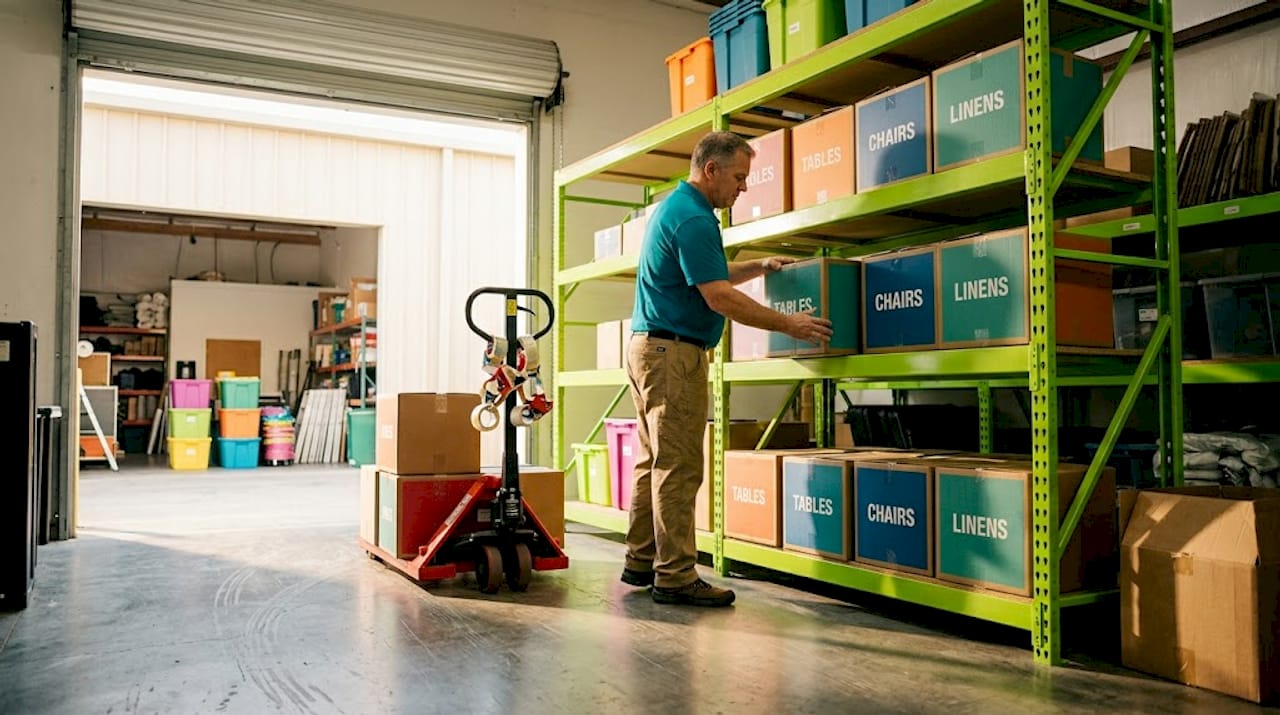
Party supply professionals organize their catalogs and quotes by product category. Each category represents a group of items that serve a similar function at an event. Here’s how standard rental industry categories are structured, covering tables, chairs, flatware, linens, centerpieces, stages, tents, and canopies as core product categories.
| Category | What it includes | Common use case |
|---|---|---|
| Tables | Folding, banquet, cocktail, round | Seating and display surfaces |
| Chairs | Folding, chiavari, padded | Guest seating |
| Flatware | Forks, knives, spoons | Dining setups |
| Linens | Tablecloths, napkins, chair sashes | Table and chair coverage |
| Centerpieces | Florals, balloons, lanterns | Table focal points |
| Stages | Platforms and risers | Presentations, performances |
| Tents/canopies | Pop-up tents, frame tents | Outdoor event coverage |
The term “turns” deserves its own explanation because it trips up almost everyone the first time. A single “turn” means one complete setup and use of a rented item during the event. If a vendor says a venue does “two turns,” it means the same tables, chairs, or linens will be used for two separate groups of guests during the event period. Weddings with separate ceremony and reception spaces sometimes involve a turn. Knowing this protects you from assuming you have more supply than you do.
Here’s a step-by-step breakdown of how to process a supply quote like a professional:
- Identify the categories listed. Look for tables, chairs, linens, flatware, and decor as separate line items.
- Check the quantities. These are usually tied to your guest count or the number of tables.
- Look for the term “turns.” If it appears, ask the vendor how it affects your total available supply during the event.
- Note the lead time. This is when your order needs to be placed or confirmed before the event date.
- Ask about delivery versus pickup. Many vendors use different pricing tiers for each option.
- Clarify what’s included in “linens.” Does it mean just tablecloths, or does it also cover napkins and chair covers?
For any celebration, understanding birthday decor basics helps you connect those industry categories to the actual decorations you’re buying or renting. And if sustainability matters to your household, reusable party decor is a concept that also ties into industry thinking about multi-turn use of supplies.
Pro Tip: Ask every vendor for a printed or emailed line item list of their categories. If they list “linens” as one item, ask them to break it down. The more specific the quote, the fewer surprises on event day.
Planning parameters: How industry lingo drives the process
Understanding core terms leads directly into how professionals actually plan, and why those terms matter in real life.
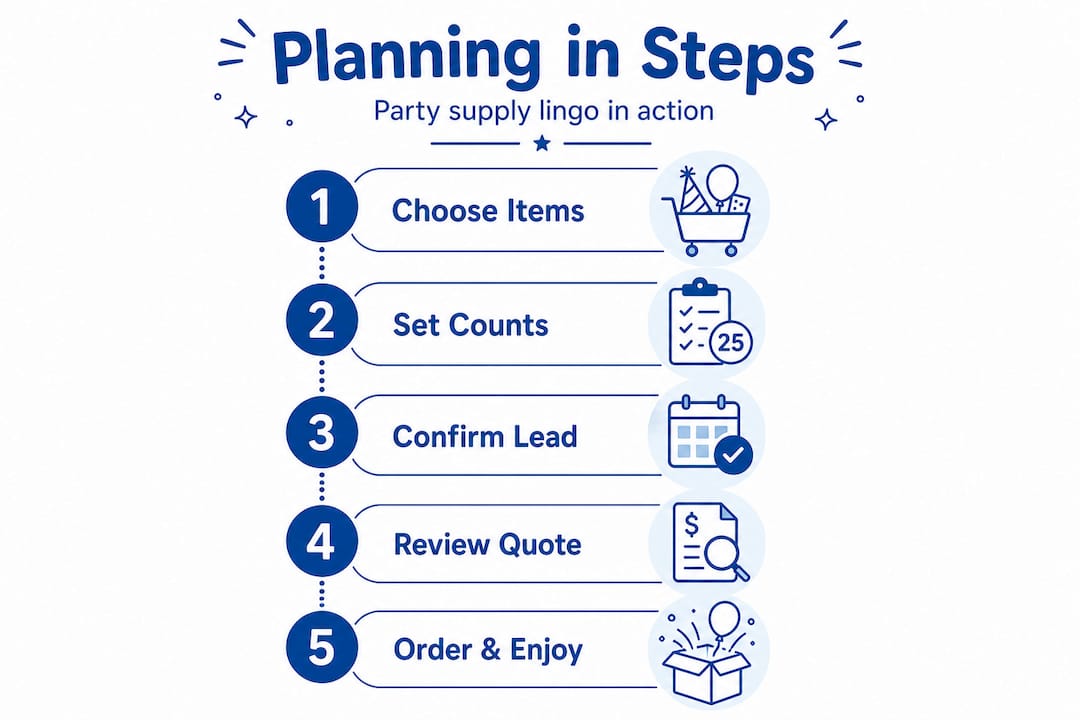
Once you understand the vocabulary, the next step is learning how professionals use specific planning parameters to structure every supply decision. These parameters are not just administrative details. They are the backbone of every successful event.
Event planning tools and guides from established B2B platforms emphasize scoping inputs like attendee count, duration, and vendor/budget deadlines as the upstream “mechanics” of event planning. In other words, the numbers you start with determine everything that follows.
| Planning approach | Starting point | Risk level |
|---|---|---|
| Theme-first | Decoration style and color | Often over-spends on decor, underestimates logistics |
| Mechanics-first | Guest count, duration, deadlines | More budget control, fewer surprises |
Here’s what mechanics-first planning looks like in practice. Say you’re hosting a birthday party for 50 guests. A mechanics-first approach means you start here:
- 50 guests requires approximately 7 tables (seating 6-8 per table)
- 50 chairs (plus a few extras for the head table or gift area)
- 50 place settings of flatware
- 50 napkins, plus extras for spills
- 7 centerpieces (one per table)
- Tablecloths for 7 tables
None of these numbers are guesses. They’re direct multiplications of your guest count. That’s how industry professionals approach supply planning, and it eliminates the guesswork completely.
Lead times are another critical mechanic. A lead time is the amount of advance notice a vendor or supplier needs to fulfill your order. For rental companies, lead times can range from 48 hours for small local orders to two weeks or more for large events during peak seasons. For retail party supplies, lead time matters if you’re ordering online and need items to arrive before a specific date.
Pro Tip: Work backwards from your event date. If your party is on a Saturday, most vendors will deliver on Friday and pick up Sunday. That means your final order needs to be confirmed by Wednesday or Thursday at the latest. Build that buffer into your planning calendar from day one.
Knowing these mechanics also helps you protect your party planning budget. Over-ordering because you didn’t account for the actual guest count is one of the most common and most preventable expenses in event planning.
Statistic callout: Event planning professionals who establish clear attendee counts and deadlines at the start of planning report significantly fewer last-minute add-ons and budget overruns compared to those who plan decoration-first without anchoring supply quantities to guest numbers.
Translating terms to action: Consumer scenarios
Let’s make this real. Here’s what knowing industry terms looks like when you actually plan a party.
Picture two scenarios. In the first, a parent planning a graduation party calls a vendor and says, “I need stuff for about 60 people, something with the school colors.” The vendor asks clarifying questions for 20 minutes, estimates quantities, and the quote comes back vague. Items get over-ordered. The budget gets strained.
In the second scenario, the same parent calls and says, “I need seating and dining for 60 guests, eight rounds at 8 per table, 60 flatware settings, linens for eight tables, and eight centerpieces. Lead time is three weeks.” The vendor responds immediately. The quote is specific, accurate, and comes in under budget.
Planning measurable parameters around guest counts and timelines, then mapping them into supply line items, is exactly how industry-oriented guides structure the event planning process. That structure is the difference between a smooth order and a stressful one.
Here’s a practical checklist you can use before calling any vendor or placing any online supply order:
- Know your guest count (confirmed, not estimated)
- Know your event duration (two hours, four hours, all day)
- Identify which categories you need: tables, chairs, linens, flatware, decor
- Calculate quantities using your guest count as the base number
- Establish your lead time (when you need delivery or arrival by)
- Ask about “turns” if your event has multiple seating rounds
- Confirm what’s included in each quoted category
Organizing party supplies ahead of time using these categories also makes setup on event day faster and less chaotic. When every item has a category, every person helping you set up knows exactly where things go.
Pro Tip: When you receive a supply quote, highlight any term you don’t recognize and ask for a definition before signing. Vendors appreciate clarity, and you’ll protect yourself from hidden charges tied to terms you misunderstood.
Knowing industry terms also gives you real negotiating power. When you ask a vendor directly, “Is the per-turn pricing the same as your flat-day rate?” you signal that you understand how rental pricing works. Vendors are far more likely to offer flexibility or alternatives to customers who understand the business language.
Perspective: What most party guides don’t tell you about industry lingo
With those practical examples in mind, here’s our candid take on what these terms really mean for everyday party planning.
Most party planning content focuses on themes, color palettes, and trending decoration ideas. That content is fun. But it skips the part that actually determines whether your event runs smoothly or falls apart. The mechanics. The language. The logistics.
Here’s what we’ve seen over many decades of supplying celebrations: the people who get burned by party planning aren’t the ones who picked the wrong balloon color. They’re the ones who ordered 30 place settings for 50 guests because they didn’t know how to read a supply quote. They’re the ones who missed a vendor’s lead time deadline and paid rush fees that blew their budget. They’re the ones who assumed “linens” meant tablecloths and discovered on event day that napkins weren’t included.
Industry lingo isn’t gatekeeping. It’s a shortcut. When both sides of a conversation use the same terms, everything moves faster, more accurately, and more affordably.
We also want to push back against the idea that this knowledge only matters for large or formal events. Even a backyard birthday for 20 kids benefits from a parent who knows to ask, “What’s your lead time on balloon orders?” or “Is your centerpiece pricing per table?” Those small questions create real savings and real clarity.
The other overlooked benefit is confidence. When you walk into a planning conversation knowing the vocabulary, vendors take you more seriously. You get better answers, clearer quotes, and sometimes better pricing. It’s not about impressing anyone. It’s about protecting your time and money, which is exactly what smart budget party wisdom is built on.
The bottom line: a little vocabulary study pays off more than any decoration trend ever will.
Get party-ready: Shop supplies and put these terms to use
Armed with expert lingo and strategy, you’re ready to make smarter, faster supply choices for your next celebration.
Now that you can read a quote, understand a category, and plan like a pro, the next step is actually pulling your supply list together. Every category we’ve discussed, from napkins and table covers to centerpieces and themed decor, is available in one place.
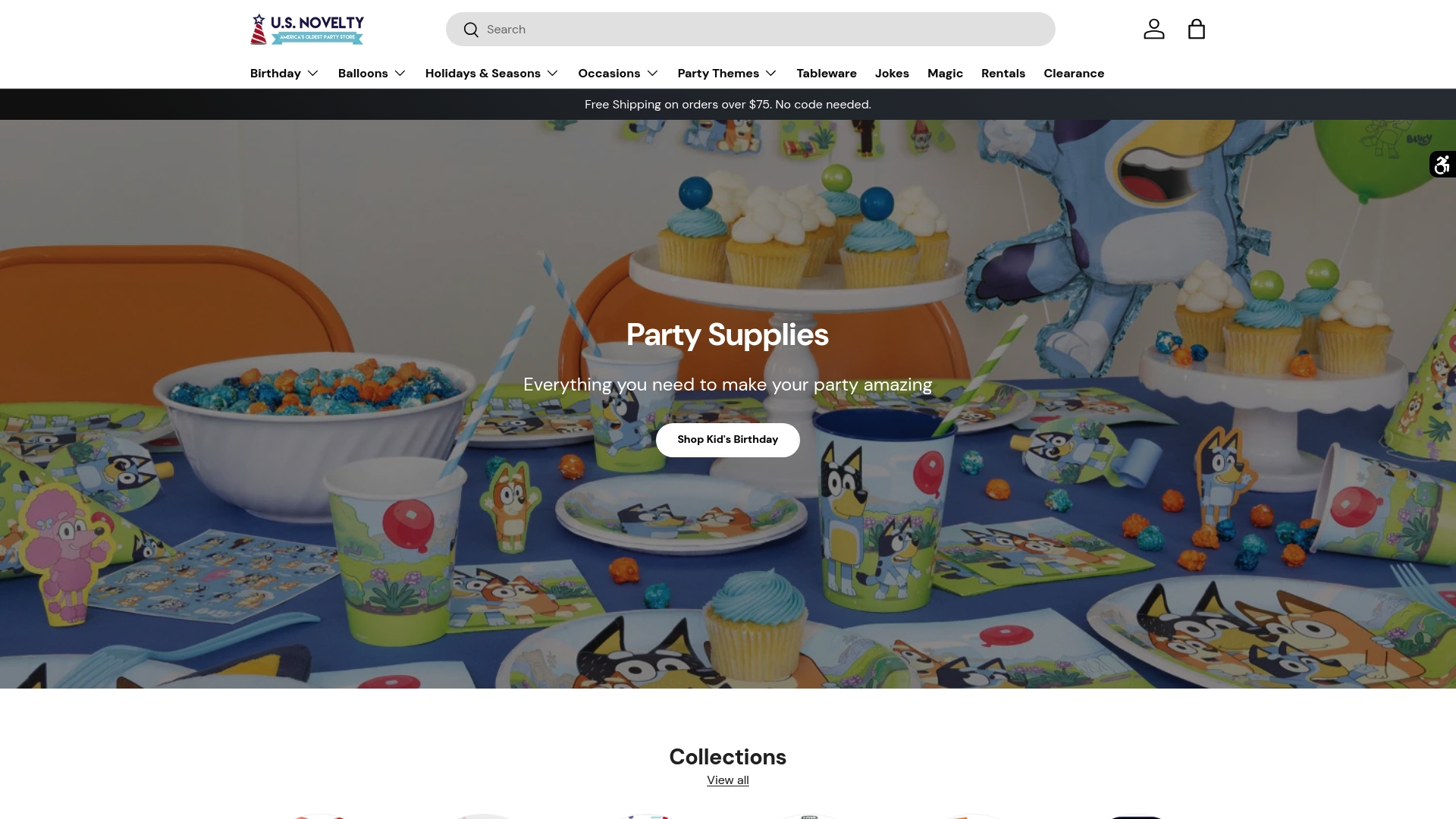
At US Novelty, you’ll find party supplies organized by category so your new vocabulary translates directly to faster, more confident shopping. Looking for linens? Browse table covers sorted by size and color. Need to stock up on flatware alternatives? Check out the full tableware section. Even something as simple as picking up party napkins is easier when you know you’re looking for a specific quantity tied to your guest count. Free shipping on orders over $75 makes it practical to consolidate your entire supply list in one order. Your next celebration is closer than you think.
Frequently asked questions
What does ‘turns’ mean on a party supply quote?
“Turns” indicates how many times an item like a table setting or chair is used during an event rental period, helping you plan for quick setups or multiple guest rounds. Knowing this prevents you from assuming you have more supply than is actually available.
Why do vendors care about attendee counts and event duration?
These numbers tell vendors exactly how much supply you need, guiding quantity, logistics, and budgeting. Without them, vendors can only estimate, which usually leads to over-ordering and higher costs.
How can using industry terms help me save money on party supplies?
Knowing industry lingo helps you avoid over-ordering and communicate efficiently with vendors, with measurable planning parameters lowering the risk of mistakes and unnecessary fees. Precision in ordering is almost always cheaper than guessing.
Is learning party supply jargon necessary for casual parties?
Even for casual parties, understanding basic terms prevents confusion and helps you order or rent exactly what you need without wasted spend. A small amount of vocabulary knowledge delivers a large return in planning clarity.
Where can I find a full list of party supply categories?
Check a party supply retailer’s website or ask vendors for their rental catalog to see all standard categories listed by function. Most reputable vendors are happy to walk you through their category structure when you ask directly.