

Short answer: no safe consumer gas reliably replaces helium for floating balloons. Hydrogen provides slightly more lift, but it’s flammable and unsafe for party use, which rules it out for anyone decorating a home, venue, or storefront. That leaves you with two real paths.
- Go air-first. Most garlands, arches, centerpieces, and balloon walls look just as good filled with air and mounted on sticks, frames, or garland tape. No gas required.
- Use helium sparingly. Save it for the handful of balloons that genuinely need to drift or bob, and rent a tank or buy a small canister only for those pieces.
Usnovelty carries the air-filled foil balloons, balloon sticks, weights, and rental helium tanks to cover either approach—often within the same order.
Key Takeaways
No consumer gas safely replaces helium for reliable balloon float, so air-filled products handle most decor while helium stays reserved for a few essential floating pieces.
| Point | Details |
|---|---|
| No safe substitute gas | Hydrogen lifts slightly more than helium but is flammable and unsuitable for parties. |
| Air-first covers most decor | Garlands, arches, and centerpieces look complete using sticks, frames, and air-filled foils. |
| Helium is for focal pieces | Reserve it for ceiling clusters or bouquets that need genuine free-floating movement. |
| Check size and product specs | Balloons under 11 inches and many mini foils are often designed for air only. |
| Usnovelty supplies both paths | Shop air-filled foils, sticks, garland kits, and weights, or reserve helium tanks for the pieces that need lift. |
Table of Contents
- Why Hydrogen and Other Gases Aren’t Real Balloon Gas Alternatives
- Safe Decoration Alternatives That Mimic Floating Without Helium
- When Do You Actually Need Helium?
- Helium Cost, Supply, and Safety If You Use It Anyway
- Building an Air-First Floating Look Step by Step
- Non-Gas Ways to Simulate Float: Frames, Drones, and Structural Tricks
- Are Alternative Balloon Gases Legal to Use in the United States?
- If You’re Ever Tempted to Try Hydrogen or Propane Mixes, Don’t
- Helium vs. Air-Filled Balloons: Which Has the Lighter Environmental Footprint
- Comparing the Real Cost of Air-First Decor vs. Helium
- Why We Push Air-First at Usnovelty
- Shop the Products That Make Helium-Free Decor Easy
- Sources
Why Hydrogen and Other Gases Aren’t Real Balloon Gas Alternatives
Hydrogen is the gas people ask about most, and for good reason: it’s cheap, light, and easy to produce. It also delivers roughly 8 to 10% more lift than helium. That number sounds appealing until you factor in the other half of hydrogen’s profile: it’s highly combustible. A static spark, a lit candle near a dessert table, or a hot light fixture is enough to ignite it, and there’s no controlling for that risk in a room full of guests.
Statistic: Hydrogen’s 8 to 10% lift advantage over helium comes at the cost of flammability, which industry suppliers repeatedly flag as operationally unacceptable for public or commercial balloon use.
Helium wins for a simpler reason than lift: it doesn’t burn. Its non-combustible, inert nature is exactly why the party and event industry standardized on it despite hydrogen being lighter and cheaper to source.
Other gases don’t solve the problem either:
- Nitrogen and argon are inert and safe, but both are heavier than air and won’t lift a balloon at all.
- Neon floats but is expensive and impractical to source for a party.
- Any flammable gas blend, hydrogen included, has no place near candles, sparklers, or heat sources at an event.
The safety directive here is simple: never use a flammable gas to fill party balloons, indoors or out.
Safe Decoration Alternatives That Mimic Floating Without Helium
You don’t need gas to make balloons look like they’re hovering. You need the right hardware and a little arranging know-how.
- Balloon sticks and cups. These hold standard 11 inch latex or air-filled foil shapes upright on a table or in a bouquet, giving you height and movement without a single canister. They work best with lighter latex and small-to-mid foil shapes.
- Air-filled foil balloons with self-seal valves. Foil shapes with a self-seal valve inflate with a straw or hand pump and stay firm for weeks. Mounted on a stick or taped to a wall, they read as “floating” from across the room. Usnovelty’s air-filled foil balloon on a stick is built for exactly this.
- Ceiling hangs with monofilament line. Clear fishing line and removable ceiling hooks let you suspend air-filled balloons overhead. From below, guests can’t tell there’s no helium involved.
- Garlands and arches. Nearly every piece in a balloon garland is air-filled and clipped or taped into place; you only need helium if you’re weaving in a few loose floating accents. Usnovelty’s garland kits and decoration guides show layouts that use zero helium.
- Weighted bouquets. A base and balloon weight can anchor a cluster of air-filled balloons so it looks like it’s floating just above the table, even though it’s fixed in place.
Pro Tip: Mix textures and heights, not gas types. A garland with a few taller stick-mounted balloons reads as more dynamic than a flat row, and nobody notices the absence of helium when the composition has depth.
When Do You Actually Need Helium?
Helium earns its cost when a balloon has to move freely through open air. Below certain sizes and in certain setups, air-filled decor simply won’t behave the way you want.
- Size matters. Standard 11 to 12 inch latex balloons and anything 18 inches or larger tend to float reliably with helium; smaller shapes often don’t hold enough gas volume to overcome their own weight.
- Check the product spec first. Many mini foils and small novelty shapes are designed for air only, sometimes with a built-in self-seal valve that assumes you’re using a straw, not a tank.
- Free-floating displays need it. A ceiling cloud that has to drift, or a bouquet meant to bob a few feet above a table without any visible support, requires actual lift.
- Run the decision checklist before you buy: How long does the display need to last? Will it travel by car? Does the venue restrict loose balloons near HVAC vents or open flames? What’s the budget per floating piece?
If the answer to all four leans toward “short display, no travel, budget-conscious,” air-first wins. If you need something to genuinely drift above a table for six hours, that’s where helium belongs.
Helium Cost, Supply, and Safety If You Use It Anyway
Helium isn’t running out overnight, but it isn’t infinite either. Medical imaging and industrial demand have put real pressure on supply, which is part of why prices and availability shift from season to season. That’s a strong argument for using it only where it counts.
- Reserve helium for focal pieces: a ceiling cluster, an entrance arch topper, a handful of table accents.
- Compare a small disposable canister against a rental tank before you buy. Tanks are cheaper per balloon at higher volumes; canisters make sense for a dozen balloons or fewer.
- Check the cylinder for damage, keep it upright and secured during transport, and never leave it in a hot car.
- If you need more than a few dozen balloons filled, renting a certified tank or ordering prefilled balloons from a supplier beats DIY canister runs on both cost and safety.
Statistic: Helium supply tied to industrial extraction means short-term price swings are common, which is why reducing nonessential helium use makes practical sense for everyday party planning.
Building an Air-First Floating Look Step by Step
Here’s the sequence that gets you a convincing floating display without a single tank of gas.
Supplies: assorted latex and foil balloons, balloon sticks and cups, garland tape or strip, adhesive dots, clear monofilament line, removable ceiling hooks, and a few balloon weights.
- Inflate balloons with a hand pump or electric inflator; twist-tie or knot each one securely.
- Mount larger foils on sticks using the built-in cup, or press air-filled shapes onto garland tape in clusters of three to five.
- Hang a garland strip along a wall or arch frame, working from the center outward so both sides stay balanced.
- For a ceiling effect, tie monofilament to each balloon and clip it to a removable hook, staggering heights by a few inches for a natural, floating spread.
- Anchor any tabletop bouquet with a weight base so it holds shape through the event.
- If you’re adding a few real helium balloons, tuck them among the air-filled cluster so they provide the movement while the air-filled pieces provide the bulk.
Pro Tip: Stagger balloon sizes within one cluster. A 5 inch, an 11 inch, and an 18 inch balloon grouped together create visual depth that a same-size row never achieves, gas or no gas.
For transport, foil balloons on sticks travel flat in a box far better than loose helium balloons, which shift and rub against upholstery.
Non-Gas Ways to Simulate Float: Frames, Drones, and Structural Tricks
Some events want the drifting look without touching a single canister, gas free or otherwise, and a giant splash balloon XL reusable inflatable water ball toy can offer a fun, novel alternative for entertaining guests outdoors. Lightweight internal frames, usually thin wire or flexible rod structures, can hold a cluster of air-filled balloons in an arc or sphere shape that reads as suspended, even though it’s fully supported at one or two anchor points. Event decorators use this for balloon “clouds” that hang low over a dance floor or entry.
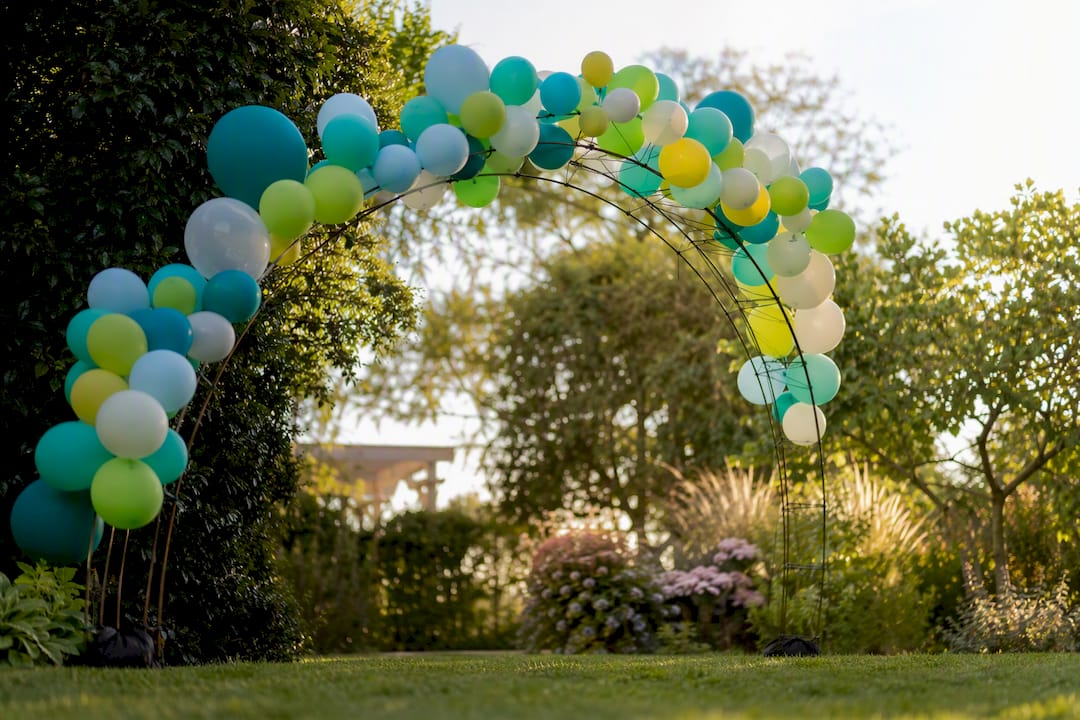
Drone-based balloon displays exist at the high end of event production, where small drones carry lightweight balloon clusters in choreographed patterns. That’s a niche, expensive option suited to large-scale corporate or entertainment events, not a birthday party or backyard shower, but it illustrates the broader point: floating doesn’t have to mean gas-filled.
For most home and small-venue setups, the practical version of “non-gas float” is structural, not mechanical. A tension rod across a doorway holding a balloon arch, a tabletop frame lifting a balloon cluster a few inches above the linens, or a foam-core backdrop with balloons wired into a floating pattern all create the illusion without any lift mechanism at all. The balloon isn’t floating; the structure is doing the work, and from a guest’s perspective, the effect is nearly identical.
The advantage of frame-based methods over drones or gas alternatives is durability. A wired balloon cloud can go up hours before an event and stay exactly in place through setup, dinner, and teardown, with none of the slow deflation that even helium balloons experience over a long evening.
Are Alternative Balloon Gases Legal to Use in the United States?
There’s no federal ban on filling a novelty balloon with hydrogen at home, but that doesn’t make it a good idea, and several practical and regulatory realities make it a bad one. Many venues, from banquet halls to convention centers, prohibit flammable gases on-site as part of their fire safety policies, regardless of federal law. Commercial party suppliers and rental companies won’t fill balloons with hydrogen at all, both for liability reasons and because most cylinder suppliers and shippers classify hydrogen as a hazardous material with strict transport and storage rules.
Helium, by contrast, is federally regulated at the extraction and industrial supply level but carries no special restriction for consumer or event use. Balloon releases, separate from the gas question, are restricted or banned in a growing number of states and municipalities for environmental reasons, so check local ordinances if your event plans include an outdoor release.
The practical takeaway: treat hydrogen and any other flammable gas as off-limits for balloons at any event with guests, regardless of what’s technically permitted where you live. Fire codes, venue insurance requirements, and basic guest safety all point the same direction. If a venue contract or local fire marshal flags “flammable gas” restrictions, that includes hydrogen balloon filling even when the balloon itself is legal to bring in.
If You’re Ever Tempted to Try Hydrogen or Propane Mixes, Don’t
Some DIY forums suggest generating hydrogen at home with chemical reactions, or mixing propane-based gases for lift. Neither belongs anywhere near a party, and here’s the safety reasoning in plain terms.
Hydrogen ignites at a very low energy threshold. A static discharge from balloon friction, a nearby candle, or a phone charger spark is enough to trigger combustion in a hydrogen-filled balloon, and the resulting flame front moves fast enough that there’s no reaction time for anyone standing near it. Propane and other hydrocarbon-based lifting attempts carry the same core problem: they’re fuel gases, not lift gases, and their entire chemical purpose is to burn efficiently.
If you ever encounter instructions for producing or using either gas in a party balloon, the correct response is to skip the method entirely, not to attempt it “carefully.” There is no supervision level, ventilation setup, or handling technique that makes a flammable gas safe inside an occupied room full of decorations, fabric, and open flames from candles or catering setups.
The only “precaution” that actually works here is substitution: replace the gas entirely with air-filled balloons, sticks, and frames, or use properly sourced helium from a certified supplier who follows standard cylinder handling protocols. If a supplier, contractor, or online seller ever offers hydrogen-filled balloons for an event, that’s a signal to walk away, not negotiate terms.
Helium vs. Air-Filled Balloons: Which Has the Lighter Environmental Footprint
Helium is a finite, non-renewable resource extracted alongside natural gas deposits, and once it’s released into the atmosphere, it eventually escapes into space and is gone for good. That’s part of why medical and industrial users have pushed to reduce nonessential helium consumption: every balloon filled with helium is helium that can’t be recovered for MRI machines or industrial applications later.
Air-filled balloons carry none of that resource cost. You’re using ambient air, and the only environmental consideration left is the balloon material itself, foil versus latex, and how it’s disposed of afterward. Foil balloons on sticks are reusable across multiple events if handled gently, which stretches their footprint even further than a single-use helium balloon that deflates within a day or two.
Balloon litter is the other side of the environmental conversation, and it applies to both gas types. A helium balloon that escapes outdoors can travel for miles before landing, while an air-filled balloon that’s improperly disposed of contributes to the same litter problem locally. Neither gas choice eliminates the need for responsible disposal, tying off, popping, and trashing balloons rather than releasing them outdoors.
If minimizing environmental impact is a priority for your event, the air-first approach wins on two fronts: it doesn’t draw down a limited natural resource, and reusable air-filled pieces reduce the total number of balloons you need to buy and discard per event.
Comparing the Real Cost of Air-First Decor vs. Helium
Helium’s cost isn’t just the gas. It’s the tank rental or canister purchase, the fill time, and often a service fee if you’re having a supplier fill balloons for you. A dozen helium-filled latex balloons from a professional filler typically costs more per balloon than the balloon itself, because you’re paying for the gas and the labor together.
Air-filled decor flips that math. A pack of latex or foil balloons costs the same whether you fill them with air or helium, but air is free and inflation takes a hand pump or an electric inflator you already own. Add in reusable sticks, cups, and garland tape, and the marginal cost per display piece drops sharply compared to gas-filled equivalents, especially at the scale of a garland or arch that might use 50 to 100 balloons.
The mixed approach, most of the display air-filled with a handful of helium focal pieces, tends to deliver the best value for money.
Rental tanks make sense once you’re filling large quantities regularly, since the per-balloon gas cost drops compared to small disposable canisters. For a single event with a handful of floating accents, a small canister or a professional fill service is usually more economical than committing to a full tank rental.
Why We Push Air-First at Usnovelty
Most of the party displays we help customers build never needed helium in the first place. Balloon sticks, garland kits, and air-filled foil shapes solve the “how do I make this look impressive” problem without a tank in sight. Customers consistently tell us the air-first setups hold their shape longer and travel better than they expected, and there’s no flammability risk to manage around candles or lighting.

Shop the Products That Make Helium-Free Decor Easy
You don’t need a gas canister to pull off a display that looks professionally done. Usnovelty stocks the pieces that do the heavy lifting: air-filled foil balloons on sticks, garland kits, balloon weights, and adhesive dots that turn a bag of balloons into an arch, a wall, or a table centerpiece in under an hour.

If a few pieces in your plan genuinely need to float or drift, Usnovelty also handles helium tank rentals and prefilled options, so you’re not stuck choosing one method for the entire event. Browse the Balloons Mini Cascade Centerpiece for a ready-made tabletop option, or check the air-filled foil balloon on a stick for a quick focal piece near an entrance or dessert table. For something with more room-filling presence, the Balloon Fun 50’ Foil Banner adds height and color without a single canister. Head to Usnovelty to build out your order, and add a reserved helium tank if your display calls for a few pieces that truly need to float.
Sources
- Alternative to Helium in Balloons: Cheap and Safe Options - TakaraTec
- Helium vs Hydrogen for Balloon Applications: Safety, Properties and Industrial Supply Considerations - Yigas Group
- What Balloons Need Helium? - GO International Blog
- Helium shortage for MRI - RSNA